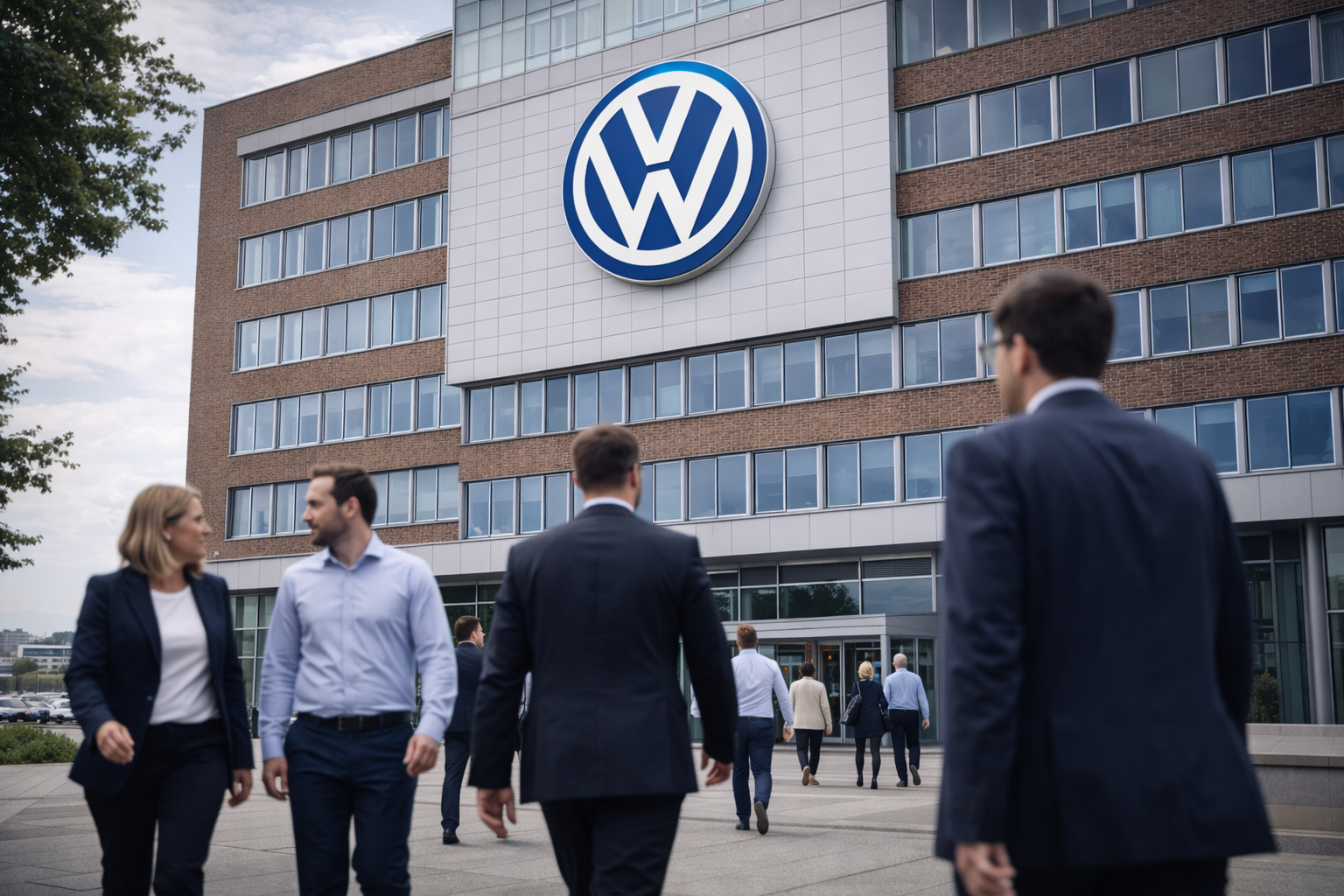
Volkswagen will cut 50,000 jobs in Germany by 2030, following a sharp decline in profits and mounting pressure from US tariffs, weaker demand in China and North America, and higher costs associated with electrification.
Europe’s largest automaker said the reductions will span the entire group, including Audi and Porsche, and form part of a broader restructuring as the business environment becomes more challenging.
Job cuts and restructuring
Chief executive Oliver Blume told shareholders the downsizing will affect all brands within the group’s German operations.
The company stated that around 50,000 jobs are expected to be cut across the Volkswagen Group in Germany by 2030.
The move builds on a late-2024 agreement with unions to reduce more than 35,000 roles by 2030 in a socially responsible manner, targeting savings of €15 billion (£12.4 billion).
Volkswagen said the additional measures reflect a “fundamentally different environment” and the need to adapt its cost base.
Profits hit by tariffs and weaker demand
Volkswagen reported a 54% drop in pre-tax profits to €8.9 billon (£6.6 billion), citing US tariffs and a costly strategy shift at Porsche.
Net profit after tax fell by around 44% in 2025, from €12.4 billion (£10.7 billion; $14.4 billion) to €6.9 billion (£6.1 billion; $8 billion), the company said.
Porsche’s operating profit nearly disappeared, falling 98% to €90 million after it postponed its transition to electric vehicles due to weak demand.
The group has also scaled back EV production targets in recent months, including at Lamborghini.
US President Donald Trump’s decision to impose 25% tariffs on car imports has further strained performance, while Chinese automakers have intensified competition in Europe.
The company also flagged a decline in demand in China, historically one of its most profitable markets.
Geopolitics, energy prices and premium brands
Volkswagen warned that global turbulence could weigh on its outlook.
The company cited challenges from the macroeconomic backdrop, potential trade restrictions, and geopolitical tensions, and noted increased volatility in commodity, energy, and foreign exchange markets.
As US-Israeli military action against Iran fuels uncertainty and raises energy costs, Blume said the conflict was not disrupting Volkswagen’s supply chain but could dampen demand for premium marques.
Volumes in the region are modest, he said, but margins are high. “We are simply seeing how volatile and fragile our world is,” Blume added.
China’s strategy and EV recalibration
Domestic competition has eroded Volkswagen’s share in China, the world’s largest car market.
In response, Blume announced “the largest product campaign in our history” in China to win back customers.
At the same time, the group is moderating its electrification plans to better match demand and infrastructure realities.
Porsche has delayed parts of its EV transition, while other brands are adjusting production schedules.
Outlook and cost focus
For 2026, Volkswagen forecast a core profit margin between 4% and 5.5%, potentially below the 4.6% achieved this year.
Finance chief Arno Antlitz said the current margin is “not sufficient in the long run” and pledged to “rigorously reduce costs,” adding, “That is what we will focus on in the coming months.”
The group expects a recovery in the coming year but emphasized that cost discipline will be central to restoring profitability.
Volkswagen’s expanded job cuts underline a push to streamline operations amid tariffs, fierce competition, and an uneven shift to battery-powered models.
Execution on cost reductions and its China product push will be key to any rebound.
The post Volkswagen to slash 50,000 jobs as profits plunge and tariffs bite appeared first on Invezz